 TgWitness
Reference / Evidence
How the evidence works
Hash chain, signatures, checkpoints and witnesses explained with the exact formulas the verifier uses.
TgWitness preserves what a collecting account observed, links those observations into a signed journal and lets another person verify an export against a trusted key and an earlier retained checkpoint.
The local documentation website adds
interactive examples at /docs/concepts/, a checkpoint decision explorer at
/docs/witness/. All example messages,
counts and delays are fictional. Hashes in the chain sandbox are calculated with
SHA-256 in the browser. Nothing is sent to Telegram.
A message changes; observations accumulate#
Diagram as text
- Telegram → Collector: New message: Meet at 10:00
- Collector → Signed journal: Append message.new
- Telegram → Collector: Edit: Meet at 11:00
- Collector → Signed journal: Append message.edited
- Telegram → Collector: Deletion notice
- Collector → Signed journal: Append message.deleted
- Note on Signed journal: Original + edit + deletion observation remain
This simplified sequence assumes Telegram delivered each update and the selected account could see it. Operational events also share the journal. A deletion notice does not supply the deleter or an exact deletion time. Repeated deliveries are separate observations; there is no journal-wide duplicate suppression.
What a hash covers#
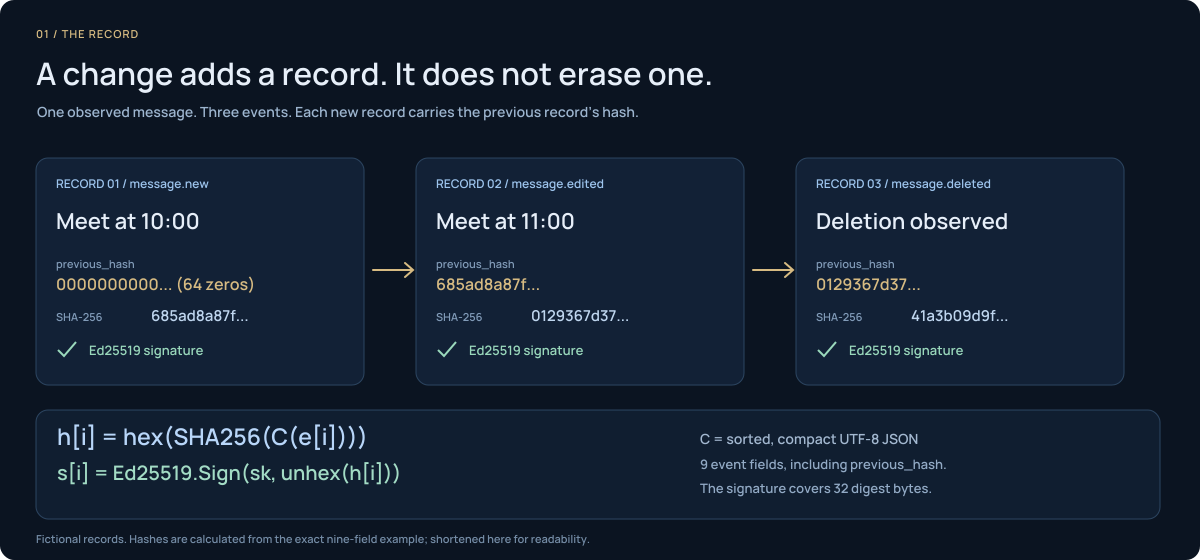
Read the formula from the inside out: C turns the nine fields into exact bytes; SHA-256 produces their digest; hex is how that digest is stored. The previous hash is already inside the event. unhex turns the stored hash back into the 32 bytes that Ed25519 signs.

Let C(ei) be the canonical UTF-8 JSON of the nine event fields. The first
previous_hash is 64 zero characters. Each later record includes the preceding
record's hexadecimal hash:
The signature covers the 32 raw digest bytes. The hash input contains exactly
seq, observed_at, source_at, kind, chat_id, message_id, actor_id,
payload and previous_hash. Object keys are sorted; whitespace and ASCII
escaping are omitted; NaN and infinity are rejected. See the
exact encoding.
Diagram as text
- 64 zero characters → Record 1 / hash h1
- Record 1 / hash h1 → Record 2 includes h1 / hash h2
- Record 2 includes h1 / hash h2 → Record 3 includes h2 / hash h3
- Record 3 includes h2 / hash h3 → Signed checkpoint: count 3, head h3 (retain elsewhere)
| Change to the supplied journal | What detects it |
|---|---|
| Alter record 2 while leaving its saved hash | Recomputed event hash differs; its signature no longer covers the changed event |
| Rebuild the altered record and every later hash | The original signatures fail; a retained checkpoint at the affected boundary also disagrees |
| Remove the tail but keep the remaining prefix intact | An earlier retained checkpoint beyond the supplied prefix reveals that the export is too short |
| Re-sign a replacement journal with another key | A separately trusted key fingerprint rejects the replacement identity |
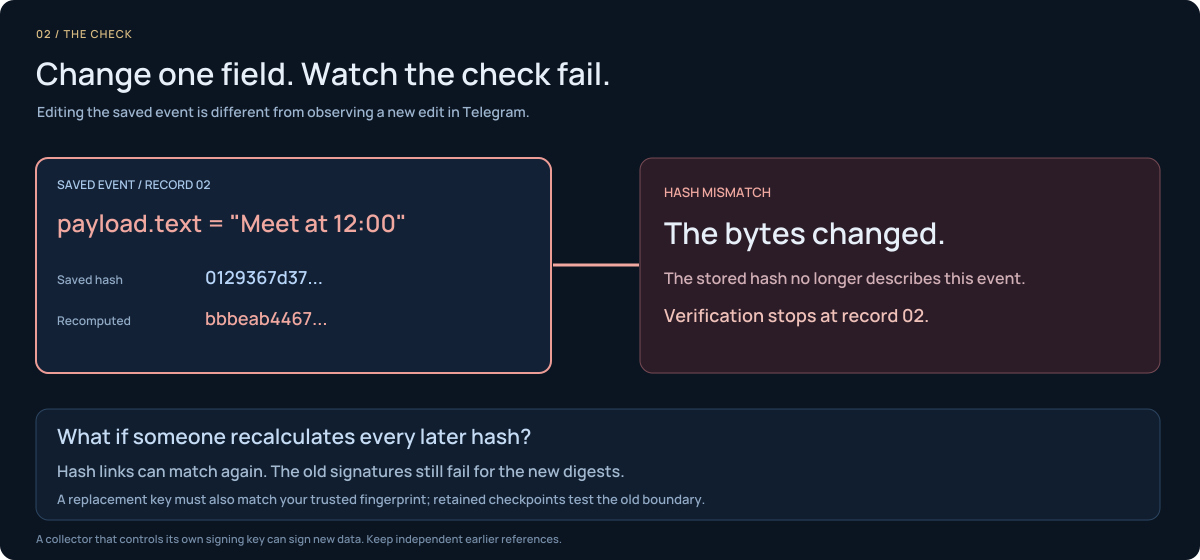
Try the logic on record 2: change Meet at 11:00 to Meet at 12:00 in the
saved event. Its recomputed hash no longer matches. Recalculating the later chain
can repair its links, but cannot make the original signatures cover the new digests.
An observed Telegram edit, by contrast, becomes a new journal record.

Hash links alone do not prevent someone from recalculating a replacement chain. Trust comes from checking signatures under an independently trusted key and comparing with references retained outside the collector.
What an earlier checkpoint adds#
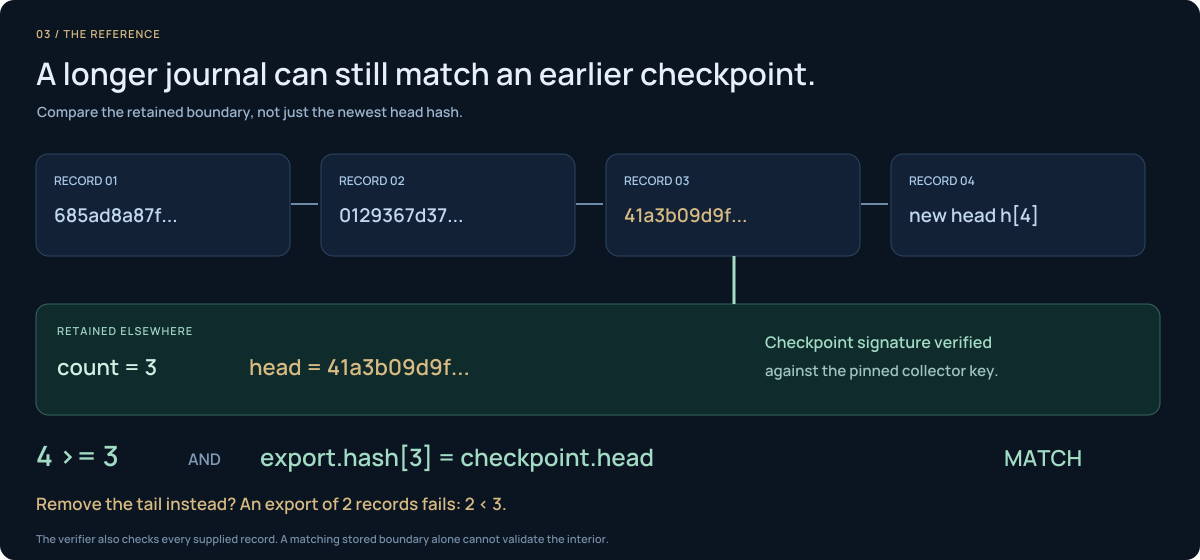
The reference stays still while the journal grows. If the checkpoint says “3 records, head h3”, a four-record export can pass by matching h3 at position 3. Its newest head is h4, which is expected to differ. An export of only two records fails.

After verifying the checkpoint signature, require:
An export may extend beyond a checkpoint. It must agree at the retained boundary. The real verifier also checks every event's sequence, previous link, hash and signature. Comparing only the final stored head would miss an altered interior record whose saved hash was not updated.
Where a witness belongs#
Diagram as text
- Collector / account session / key A → Read-only checkpoint endpoint
- Witness / pinned collector key / own key B → Separate signed witness journal
- Witness / pinned collector key / own key B → Read-only checkpoint endpoint (Request a check)
- Read-only checkpoint endpoint → Witness / pinned collector key / own key B (Signed answer)
- Witness / pinned collector key / own key B → Channel with signed TGW1 posts (Bot API / own token)
The witness records rollback, a different head at the same count, changed keys, invalid answers and missing responses. A larger count alone does not establish that every earlier record remains unchanged; compare the export with retained checkpoints. A witness on another host avoids sharing the collector's host outage; a separate operator gives additional independence.
The witness attests to the collector's reported journal state. It does not independently observe all Telegram messages. See witness setup.
Test delivery against known actions#
Use a controlled group, distinct collecting accounts and a fresh marker. Send, edit and delete deliberately, checking capture between stages. Define the expected actions and a cutoff before inspecting the results.
Only matched expected actions count; duplicate receipts do not increase the numerator. The denominator must be nonzero. A missing receipt has no measured delay. Document clock uncertainty; use your own controlled deletion action time, because Telegram does not provide the exact deletion time. A result such as 5/6 (83.3%) describes the test actions, not the completeness of all Telegram traffic.
Pick a workflow#
The complete investigation walkthrough follows an incident across a channel, group, bot and private chat:
- Enable whole-account Investigation mode and inventory every accessible chat.
- Acquire journal snapshots, per-chat full history and preserved attachments.
- Keep live changes and any deliberate panel interactions with their receipts.
- Follow numeric sender IDs, reply relationships, repeated destinations and file hashes through cited records and people profiles.
- Reconstruct a cross-chat timeline with both timestamps and explicit gaps.
- Compare other account workspaces while keeping their origins and keys separate.
- Assemble and verify the signed journals, profiles and history exports with case notes.
The website's /docs/cases/ guide includes an interactive case map and variants
for bot disputes, removed messages and participants changing names. Case notes
and cross-workspace analysis are external; the application does not automatically
generate a global investigation graph or a merged case archive.
Completed validation and remaining work · Export and verify · Start with one account