 TgWitness
Reference / Archive & integrations
Case Board: Source-Linked Telegram Annotations
Bookmarks, exact highlights, action slices, discussions, scoped access and the signed annotation history used by Case Board.
TgWitness / Documentation · Investigation
Case Board gives an investigation team a shared working view of saved material. Bookmark an observation, highlight an exact passage, save a range of actions, and discuss it with colleagues. Cards retain their source references and signed revision history. Team annotations stay in the workspace, separately identifiable from the original Telegram observations.
Evidence model · Access · Reports
Work with a case#
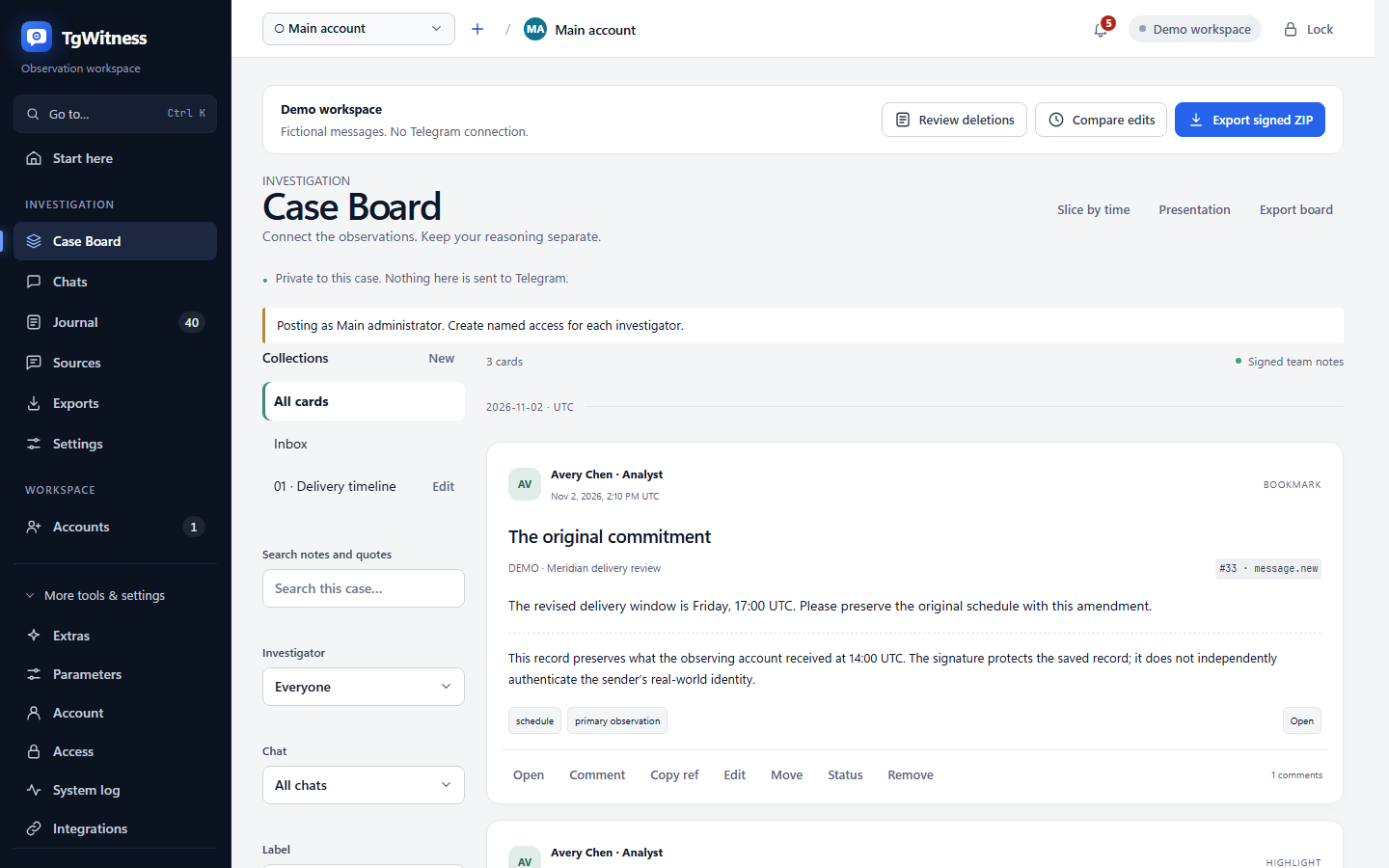
Open Investigation → Case Board in Standard or Expert mode. The language follows the panel. Use To board beside a journal record or saved chat message, or focus it and press B. The bookmark is added to Inbox in one click. Edit its title, labels and note, or move it to a collection. A changed card appends a signed revision; removing it preserves the history.
For a first case, choose a collection and add the records that answer one question. Use comments to review the interpretation, then Presentation to walk through the cards and source context. Choose Case Board material separately in Report studio when preparing the deliverable. Saving a slice does not automatically configure a report's data filters.
Select text inside a saved chat message to reveal Highlight → board. Select its colour and add a note. The server checks the exact quote and saved version, including emoji, RTL text and combining marks. The interface does not map a selection through masked or transformed text.
Shift-click two records in one chat for Slice between, use Slice by time, or save the journal's current chat, period and event-kind filters. A saved slice has its own authoritative predicate: opening it in Journal also applies multiple chats, message-number limits and actor filters. Show records added since bookmark isolates the later additions. Changing Journal filters exits the slice. From People, Slice this person’s actions uses the recorded actor ID; it does not assume that the message author edited, deleted or reacted to a message.
The slice dialog previews counts before allowing creation. all includes every recorded kind,
including snapshots, edits, deletions, reactions, membership/service updates, own actions,
buttons, media outcomes, recovered messages and future event kinds. The selection describes
saved observations. Unknown-chat deletion notices are separate context,
available only to a whole-workspace access, never attributed to one of the chosen chats.
Collections have a declared chat scope. An empty scope means the whole workspace. A collection cannot contain cards outside its scope; a chat-limited participant cannot read a broader collection. Inbox is a virtual collection for unassigned cards. Search and filters cover visible cards only; threads and mentions inherit the parent card's access. Removed comments have a tombstone in the discussion. No viewer history is recorded.
Presentation opens all cards in the chosen collection, with Card, Source context and Team comments views and keyboard Previous/Next controls. It provides no editing controls. The ordinary feed is paginated; presentation loads its list in pages and retrieves one card's detail at a time.
Permissions#
All operations require view, workspace/chat scope and board.read. board.write adds cards,
comments, moves and open/review statuses. board.manage permits collection management,
confirmed/dismissed statuses, revisions/removal of someone else's card. A status is a team
decision, not a cryptographic verification result.
Access form presets: Reviewer = read; Analyst = read/write; Operator = read/write/manage, in addition to their existing permissions. Existing grants do not silently acquire new rights. The main administrator has all rights, and posts as Main administrator. Use named grants for attribution. Mentions list only current accesses able to read the complete parent card.
A grant for chat A cannot obtain a card or slice for A+B, even by guessing its ID or supplying a
false target.chat_id. Target metadata is resolved from the signed event hash on the server.
Collections, discussion counts, related cards and live notifications are filtered before response.
Exports require export as well as board.read; an existing exporter without board access gets
the ordinary evidence archive without team notes. SSE rechecks current grants before each batch.
Stored contracts#
Like observations, annotations are written transactionally to an append-only SQLite table in
the workspace. annotations.jsonl is its exact canonical export from the same read snapshot as
events.jsonl. There is no second competing annotation store and no board.activity journal event.
Each line has exactly:
{
  "seq": 1,
  "at": "2026-11-02T14:00:00.000+00:00",
  "access_id": "admin",
  "access_label": "Main administrator",
  "kind": "board.bookmark",
  "payload": {"id": "32 lowercase hex digits", "target": {"event_hash": "64 lowercase hex digits"}},
  "previous_hash": "64 zeroes for the first record",
  "hash": "SHA-256 described below",
  "signature": "base64 Ed25519 signature"
}
The abbreviated example above illustrates the envelope; actual payloads include their model
defaults and server-resolved target fields. API request schemas are under
tgwitness/schemas, generated from the runtime Pydantic
models by python tools/build_board_schemas.py. Extra request fields are rejected. IDs are
generated server-side when omitted. Authorship, time, snapshot and signature cannot be supplied
by the caller. Named grant IDs follow Access's existing 16-hex format; card IDs are 32 hex.
Canonical JSON is UTF-8, sorted object keys, no whitespace between tokens, unescaped Unicode,
and no NaN/infinities. The annotation hash is SHA-256 of the canonical object containing
format: "tgwitness-annotations-v1" and all seven envelope fields through previous_hash.
This format tag separates its hash domain from observations. The signature is Ed25519 over the
32 raw hash bytes. Sequence starts at 1. Revisions retain the card ID and name the preceding
annotation hash in supersedes; they cannot change chat scope. Moves, statuses and removal are
separate records. The SQLite table rejects UPDATE and DELETE.
case-board.json contains {statement, signature}. The canonical statement is signed by the
workspace key and contains format: "tgwitness-case-board-v1", public_key, created_at,
journal_head, meaning, and state. State is deterministic replay: annotations_head, an
ordered items array (collections, cards, comments including tombstones), and status_history.
Items retain their last annotation hash, sequence, author and time, as well as the original
creator and creation time across revisions. Replay checks revisions,
parents, collection references and duplicate action IDs. manifest.json and new checkpoints
also bind annotations_head. Retain a checkpoint independently to detect truncation or rewriting
with a copied signing key.
Text versions#
range.start is a zero-based Unicode code-point offset, length is a positive code-point count,
and quote must equal the exact substring of payload.text or payload.caption at the target
event. No NFC/NFKC, case folding or grapheme normalization is applied. Python string slices and
JavaScript Array.from(text) implement the same indexing. Combining marks and ZWJ emoji may
occupy several code points. range.version is the target event hash, not the current message
version or Telegram's UTF-16 entity offset. Later edits never relocate a highlight automatically.
Slice identity and time#
query accepts exactly one chat_id or nonempty chat_ids, optional inclusive from/to,
inclusive message-ID bounds (one chat only), kinds: "all" or exact/prefix wildcard kinds,
explicit actors, search, hide_system, and include_unscoped. Journal kind groups expand to
their exact predicates. Search uses the journal's NFC/case-folded payload search without altering
signed source text. Dates require a timezone and normalize to UTC.
Dates filter observed_at. Telegram's source_at is displayed separately. A deletion without
a source timestamp has no invented deletion time. A late record observed outside a time interval
does not enter it; a message-ID slice can include a later deletion for those message IDs.
snapshot fixes creation time, the journal sequence/hash boundary, matching count, first/last
sequence and result_hash. The latter is SHA-256 of the UTF-8 canonical JSON array of matching
event hashes sorted lexicographically, including [] for an empty slice. It also carries exact
kind counts and a 24-bin observation-time miniature. A slice stores a query, not duplicate source
records. At export, board/slices/<id>.json lists current hashes and added/removed sequences.
The verifier reconstructs the original result at the creation boundary, then the current result.
Added records are reported as a change fact. Removing an original event breaks the immutable
evidence chain; it is not silently accepted as an ordinary removal from a slice.
Reaction snapshots have incomplete recent-actor lists. The explorer compares adjacent snapshots of the same chat/message, including a predecessor outside the slice, and reports aggregate count deltas between observations. Missing recent actors are not claimed to have removed a reaction. The first snapshot has no inferred earlier state. Actor observations remain attributed to the snapshot in which they were supplied, not to an invented action time.
API and exports#
GET /api/board accepts collection/chat/author/label/state/from/to/q/kind/comments, offset/limit
and newest/oldest order. GET /api/board/card/{id} returns a card, source preview, thread,
status history and related cards. The participants subroute returns eligible mention choices.
POST /api/board/{bookmark|highlight|slice|collection|comment|status|move|remove} appends a record.
POST /api/board/slice-preview calculates a query. Slice records are paged at
GET /api/board/slice/{id}/records; recomputation always uses the current stable read snapshot.
Live /api/stream emits payload-free board notifications, separately from journal cursors.
GET /api/board/export returns a signed document. Chat-limited access receives a clearly labelled
signed disclosure, never another chat's annotations or the full chain. Full evidence ZIPs
carry annotations.jsonl, signed case-board.json and slice JSON appendices. HTML/PDF/JSON report
settings select no board, bookmarks/slices without discussion, or cards with comments. The
section explicitly separates team opinions from observations. Report data filters restrict the
readable notes too; full signed source files in the evidence ZIP remain complete.
GET /api/board/slice/{id}/export produces a signed tgwitness-board-selection-v1 JSON excerpt;
?format=csv produces a convenient table without a standalone signature. Keep the JSON and ZIP:
python -m tgwitness.verify evidence.zip --fingerprint TRUSTED_KEY_SHA256 --board
python -m tgwitness.verify board-slice.json --evidence evidence.zip --fingerprint TRUSTED_KEY_SHA256
python -m tgwitness.verify case-board.json --evidence evidence.zip --fingerprint TRUSTED_KEY_SHA256
The selection check authenticates the signed statement, exact source records and completeness of its query at the specified boundary. The evidence ZIP may be newer but must contain that prefix. A dangling target is reported explicitly. A different original slice snapshot, changed annotation, mismatched replay state or changed source fails. Old archives without annotations retain their existing verification behavior.
Handover defaults to Do not include. Explicit inclusion projects cards through the already
minimized records, omits inaccessible/omitted targets, withholds highlights whose source text
was minimized, cleans team text with the same mention/contact rules, and optionally replaces
investigator labels with R01, R02… in metadata and known occurrences in notes. No original
annotations.jsonl is disclosed. The signed tgwitness-case-board-handover-v1 sidecar and report
contain the same minimized material. Slice counts describe disclosed records only, with original
snapshot/query actor details withheld. Free-text names not known to the minimizer still require
review, as they do in ordinary handovers. This derivative does not claim to preserve original
annotation signatures after redaction.
Operating limits#
Parameters include soft limits of 10,000 cards and 50,000 comments, a slice page of up to 5,000 records, and media-preview control. Soft limits warn without deleting history. Feed pages are at most 200 cards. Standalone JSON slice excerpts are capped at 64 MiB; narrow the query or use the signed ZIP for larger material. The standalone verifier caps annotations replay at 256 MiB. No external comment notifications are enabled or implemented by Case Board.
The feature's automated acceptance uses fictional data and a simulated Telegram transport to check storage, access, rendering and exports. See verification scope for the scope of the evidence checks.